
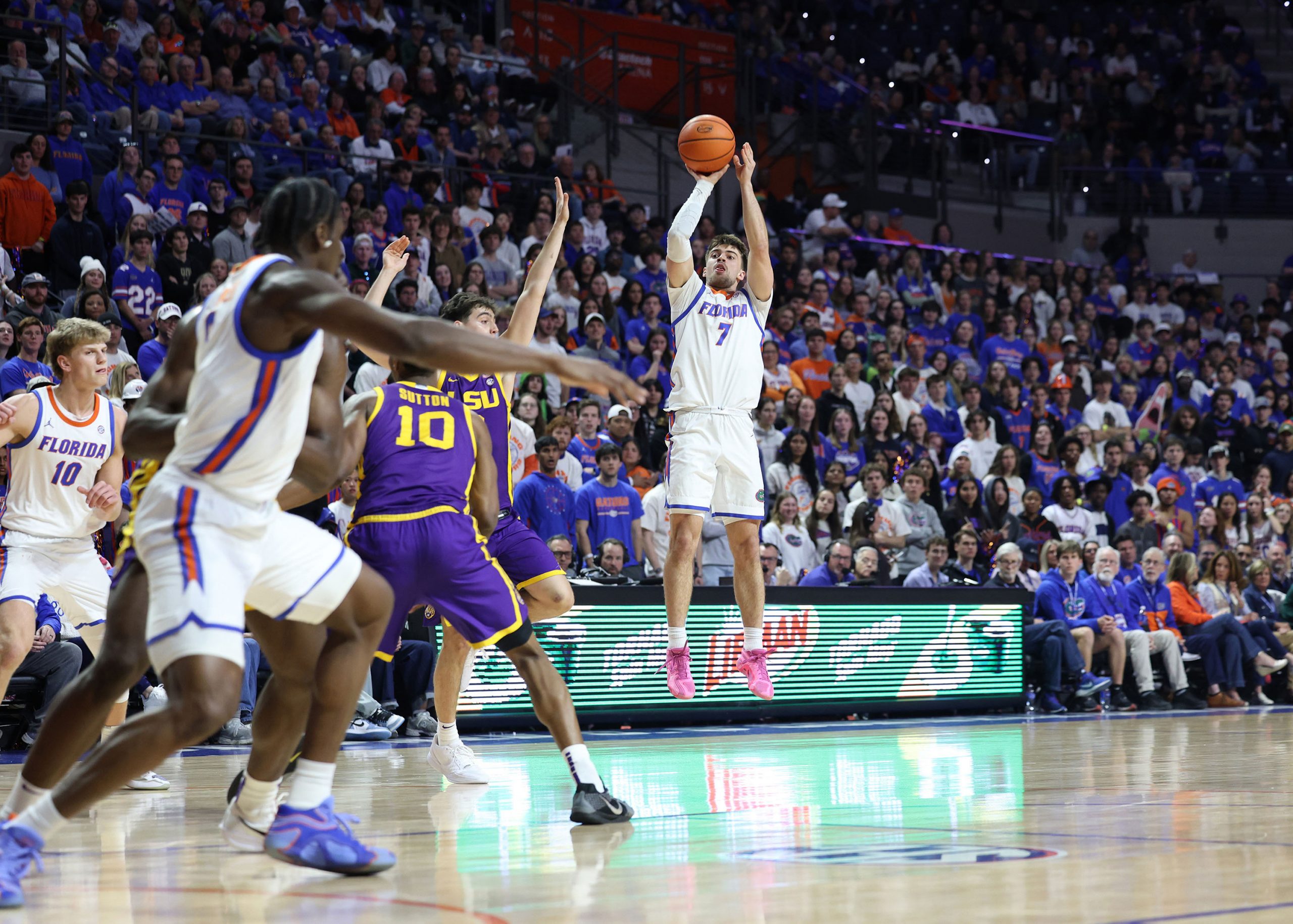
Florida’s Defense-First Style Faces 3-Point Reality in NCAA Tournament
In an era of college basketball defined by spacing, pace, and three-point shooting, the 2026 Florida Gators are winning in a way that feels almost old-fashioned. While modern contenders earn wins by stretching defenses beyond the arc, Florida has climbed to the top of college basketball by dominating the glass and suffocating opponents defensively.
The formula has produced wins — plenty of them — but as March Madness approaches, one question looms: can a team that struggles from three-point range truly contend for a Final Four in today’s game?
Florida ranks 316 out of 361 eligible Division-I teams in three-point shooting, a sharp contrast to its top-five rebounding numbers, its position atop the SEC standings, and its No. 4 ranking in the most recent AP Poll. The Gators are currently shooting 31.25% from beyond the arc — an improvement from 29.2% two weeks prior, but still well short of the 35-38% range typically seen among Final Four teams. For reference, the last Final Four team to shoot below 35% was 2024 NC State at 34.7%, still significantly higher than where Florida sits today.
This decline represents one of the most notable statistical drops from last season, largely following the departure of guards Walter Clayton Jr., Alijah Martin and Will Richard, whose perimeter shooting helped guide Florida to the 2025 National Championship.
Florida’s identity this season has been defined by physicality. The Gators lead the nation in rebounding, averaging 45.5 boards per game — nearly four more than the national average — consistently creating extra possessions and limiting second chances on the defensive end. That approach reflects head coach Todd Golden’s broader philosophy.
“We collectively, as a staff and as a program, think of our three-point shooting as a cherry on top,” Golden said. “We don’t want that to be what makes us good or what we rely upon to be a good team.”
Their success is rooted in a physical, size-driven frontcourt anchored by junior center Rueben Chinyelu, whose presence sets the tone for Florida’s interior dominance. Combined with an elite defensive rating — fourth nationally on KenPom — the Gators control games through effort down low rather than perimeter scoring.
SIGN UP: JOIN WRUF / ESPN GAINESVILLE BRACKET CHALLENGE
History offers several teams that resemble this Florida group, but with one important distinction. Programs like 2000 Michigan State, 2013 Louisville, 2014 UConn, and 2019 Texas Tech built their tournament runs on the same foundation Florida relies on now — elite defense, physical rebounding, and controlling pace. Michigan State paired that identity with a 37.8% three-point mark. Louisville and UConn both hovered around 33% from deep, yet neither finished cutting down nets. Even Billy Donovan’s championship Florida teams won through toughness and interior play, yet still shot comfortably in the upper-30s to lower-40s — 39.2% in 2006 and 40.9% in 2007.
The identities match. The efficiency from beyond the arc does not. Nearly every comparable team mirrored Florida’s style of play, yet none entered March shooting like the 2026 Gators.
So what does that mean for Florida’s ceiling? Elite rebounding and defense consistently translate to tournament success, giving the Gators a built-in edge. Their field goal percentage of approximately 48% and free-throw shooting above 70% align with past contenders — a foundation strong enough to compete with anyone.
But the ultimate upside may hinge on timely perimeter shooting.
“The ceiling is crazy if we shoot 50%, especially having these guys under the rim,” guard Urban Klavžar said plainly after Florida’s win at Ole Miss. “They do an exceptional job every game, but there are going to be times where we’re going to have to make some huge shots from 3.”
Recent performances suggest progress. In a dominant win over No. 20 Arkansas, Florida shot 56.5% from the field and 42.1% from three while holding the Razorbacks to 40% shooting, the kind of complete performance the Gators had rarely put together all season. Then came their shooting performances in the regular-season finale and SEC Tournament. Florida is 2-1 but shot just 24.6% combined in those three games, a reminder that the perimeter issues haven’t gone away so much as gone quiet.
That inconsistency is what makes Florida so hard to project. On their best nights, they look like a team capable of beating anyone. On their worst, the margin for error shrinks to almost nothing, where one cold stretch from the outside could end an otherwise dominant run.
The Gators open the NCAA Tournament Friday in Tampa with a chance to do something almost no team this century has done — win a national championship without leaning on the outside shot. Whether that’s a blueprint or a cautionary tale is what March Madness will decide.
Category: Feature Sports News, Gators Men's Basketball