
Florida Gymnastics’ Secret Weapon: Rotation Order?
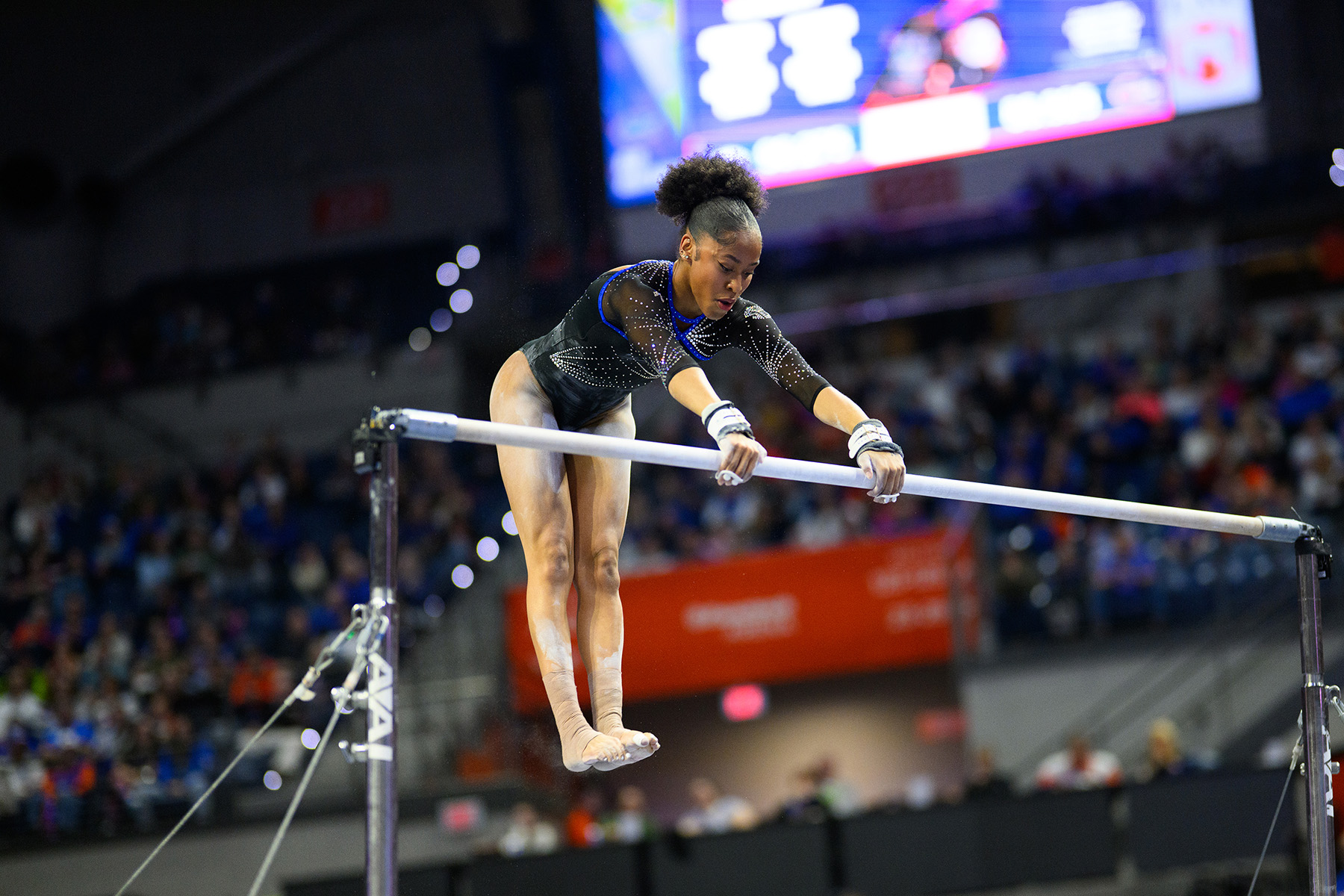
In a last-ditch effort, Florida gymnastics soared past Oklahoma to secure its 13th SEC Championship. The Gators finished the meet on their strongest event, bars, earning their highest score of the season (49.8), which doubled as the highest score in the nation this season.
Though Florida’s talent is undeniable, it went into the SEC meet as underdogs. Few expected it to surpass No. 1 Oklahoma (who it previously lost to) and No. 2 LSU (who it snuck by in early March). However, one thing was different for Florida. The event rotation for the SEC championships was unlike any the Gators had participated in this year. Their rotation started on beam, moving to floor, then vault and finishing on bars. That event-style rotation is unique to the SEC championships as most dual meets don’t follow that layout. The two quad meets the team competed in during the regular season also differed from their championship rotation.
Why?
Typically, for postseason meets, rotation order is based on rankings, with the highest-ranked team earning the traditional Olympic order (vault, uneven bars, balance beam, floor). With Florida entering as the No. 3 seed, it started on beam.
A follow-up: Was that rotation the key to Florida’s inspired performance?
Statistically, the Gators highest-scoring events are beam and bars, leading the country, in fact, on both apparatuses. However, their weaker events, floor and vault, have kept them out of the top five in the country. Starting and ending the meet on their top events could have been the difference between a championship win and going home empty-handed. Florida opened the meet with a 49.525 on the beam, putting it ahead out of the gate, which was crucial for momentum.
And, although the strong start on beam helped propel Florida to the championship, it was its stellar bars routine that secured the victory. The Gators have a notoriously stacked bars lineup, and this meet featured a typical result in that arena. Every gymnast scored a 9.9 or above, with Selena Harris-Miranda scoring a perfect 10, to help leap Oklahoma in the final standings.
What does this mean ahead of regional competition? Going into regionals, the Gators are the highest seed in their bracket, as they compete in the second round against No. 14 California, No. 20 Penn State and the winner of Arizona vs. Arizona State. Although the rotation is not set, Florida will most likely rotate in the traditional Olympic order. However, on the road to nationals, its SEC-winning rotation may be the hidden key to a national championship. Florida has not won the title since its three-year run in 2013, 2014 and 2015. A national championship would also mark the first for head coach Jenny Rowland, and rotation order — sandwiching Florida’s worst events — could be the difference.
Also of note: Oklahoma and LSU, whom Florida just upset, are bound to reach the national championships, as they have dominated the competition for the past four years. Although Florida beat the two teams during the SEC championships, doing so a second time isn’t guaranteed. And while the Gators aren’t guaranteed to see the rotation that allowed them to beat the Sooners and Tigers once, especially in the early rounds of post-season competition, it’s one that could potentially push Florida to a national championship, if they were to face again.
Up Next
The NCAA Tempe (Ariz.) Regional for the Gators starts at 10 p.m. ET Thursday in Desert Financial Arena. UF will compete with No. 14 California, No. 20 Penn State and Arizona State in Session 2, while No. 6 Georgia, No. 11 Michigan State, No. 24 BYU and Southern Utah go at it in Session 1 at 4 p.m. ET. Both sessions will be carried on ESPN+.
The top two teams from each session move ahead to Saturday’s final, with the top two teams advancing to the NCAA Championships set for April 16 & 18 in Fort Worth, Texas.
Category: Feature Sports News, Gator Sports, Gators Gymnastics