NBA Draft Risers, Fallers from March Madness
Playing basketball in the SEC gives the Florida Gators the opportunity to play against the best of the best throughout the regular season. For other teams, their first chance to play against premier competition comes in the NCAA Tournament.
March Madness gives players with NBA dreams a chance to shine for scouts on the biggest stage. Some rise to the challenge, while others see their draft stock slide with subpar play.
Of the 12 players who helped or hurt their draft stock the most, seven played for or against the Gators in either the preseason, regular season or postseason.
Risers
The risers are the players who have showcased through the tournament that they are capable of being a contributor, or even a star, at the next level. One of these players led his team on a surprise run to the Elite Eight, while the other three are still playing in the Final Four.
Bennett Stirtz
Stirtz was one of the surprise stars of the tournament. He played 40 minutes in each of the four Iowa tournament games, but it was not just his ability to stay on the floor that impressed. Across 160 minutes of action, he only turned the ball over three times. That includes a zero turnover game against the No. 1 seed Florida Gators in an upset victory.
Entering the tournament there were no questions of Stirtz’s ability to score. He averaged just under 20 points in the regular season, and went for multiple 30-point games. In the postseason, he showed he does not have to be hitting his shots to contribute. He shot just 25.6% from beyond the arc, yet still led Iowa to three wins.
Stirtz was more turnover prone in the regular season, but showed NBA teams he could be trusted to handle the ball in pressure situations. A team looking for an immediate contributor could find just that in Stirtz, who has firmly planted himself in first-round pick territory.
Koa Peat
Peat started his freshman campaign with a bang, going for 30 points, seven rebounds and five assists in an opening-night win against the Gators. But as the season went along, the Arizona Wildcats began to rely on others to carry the load. Brayden Burries led the team in scoring, while senior guard Jaden Bradley had multiple scoring bursts in close victories.
While Arizona has not been tested yet, Peat has performed. He is up to 17.5 points per game on 54.2% shooting. He is playing his game, as he has not attempted a single 3-pointer across four tournament games. His outside shooting is his biggest weakness, as he has only made six 3-pointers on the season.
This may limit him in the NBA, but for now he is showcasing to teams he can compete without the jump shot. He recorded a double-double against Utah State in the second round, and is averaging 6.8 rebounds in the tournament.
Peat will look to continue shining in the Final Four, where he will be matched up against Michigan star Yaxel Lendeborg.
Yaxel Lendeborg
Talk about stepping up when called upon. Lendeborg was named Big Ten Player of the Year, but that title means nothing once the tournament starts. He had proven himself as a decent 3-pointer shooter through the regular season, but has taken it to another level. Through four games he has hit 50% of his attempts.
The all-around production has been what teams will be most excited about. 21 points, 7.3 rebounds and 4.3 assists with less than a turnover per game. His game has shown flashes of what Scottie Barnes has done with the Toronto Raptors.
Lendeborg is a senior, which will give teams pause about his potential upside. He is answering those concerns by showing he can compete with the best of the best already. There is no need for concerns about his ceiling if his floor is as high as he is showing it to be.
Teams near the back of the lottery which are looking to compete immediately will be taking a long look at Lendeborg.
Keaton Wagler
In a loaded class of freshman guards, Wagler sits as the one who can say he is leading his team to the Final Four. It has become a trend for teams to try to find big guards who are great passers. While many have not turned out the way teams would have liked, Wagler appears to fit the mold.
Just looking at his first-round game against Penn, where he went for 18 points, seven rebounds and seven assists.
He looks to be a triple-double threat, with multiple games in the regular season with 10 assists, and the size at 6-foot-6 to rebound at the next level. Illinois leaned on Wagner in the Elite Eight, and he delivered with 25 points on 47.1% from the field.
Wagler has continued to flash the elite shooting touch as well. He shot 40% from the 3-point line in the regular season, and has upped that to 44% in the tournament. David Birch, Wagler’s high school coach, talked to ESPN about how strong Wagler is as a player.
“He just always found a way to contribute to winning,” Birch said.
While point guard is one of the deepest positions both in the NBA and in this draft class, Wagler is looking like a can’t-miss prospect.
Fallers
The fallers are players who left something to be desired through their play, or lack of play, in the tournament. One may return to college, while another is here more because of what the players in his draft range did than anything he struggled with.
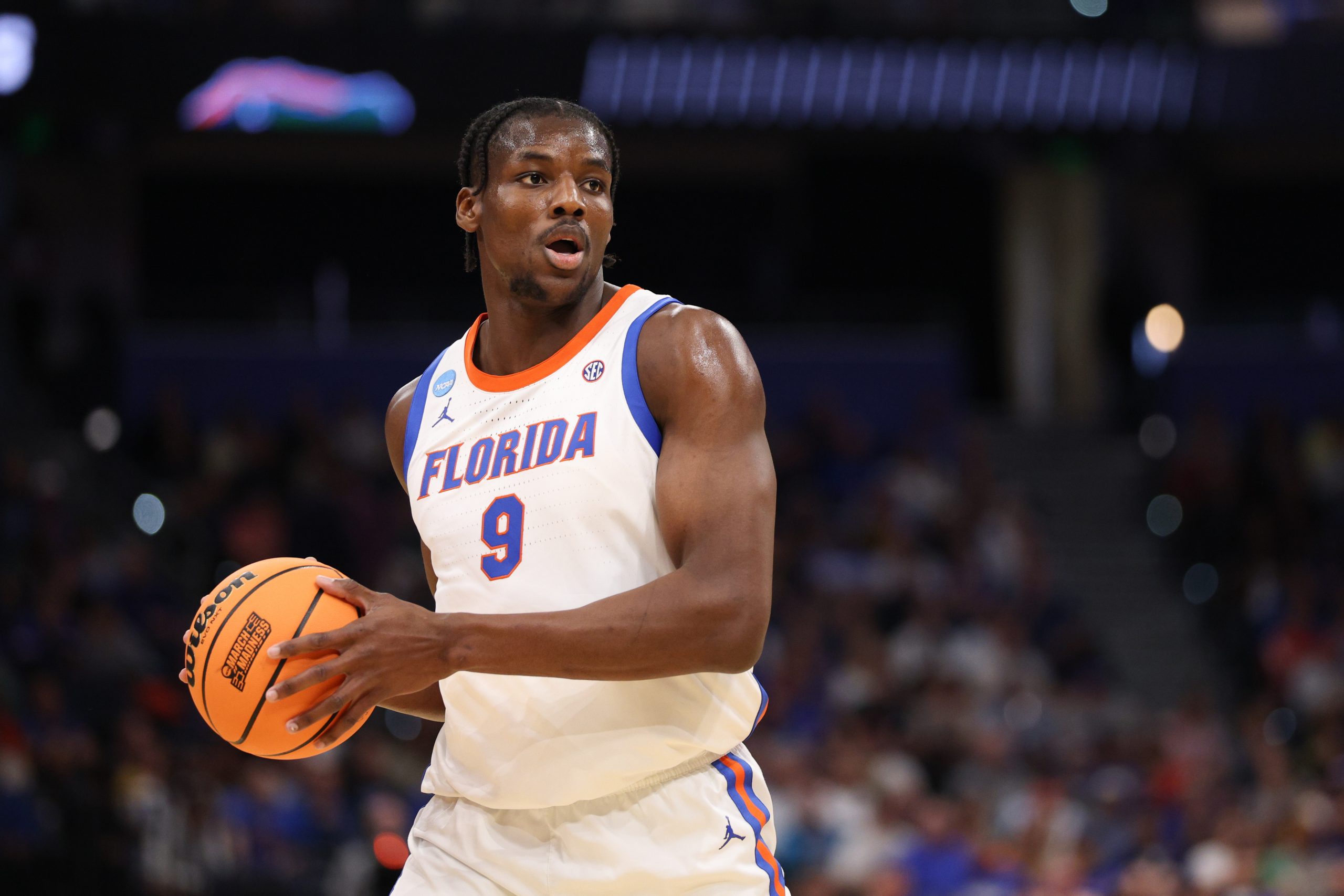
Rueben Chinyelu
The Gators exit in the second round was disappointing across the board, but for Chinyelu specifically it goes a step farther. He was non-existent in the loss. After averaging a double-double in the regular season, he had no points and one rebound.
Part of that can be explained away by the fact that he was in foul trouble, but when the team needs a player to step up, they cannot simply disappear. Florida coach Todd Golden put it plainly when it came to the whole team.
“I thought they were physically tougher than us in the first half,” he said.
Chinyelu was the one who set the tone physically for the Gators. It was not there against Iowa. There were already questions about how his game would translate to the NBA. He has been compared to former Wooden Award winner Oscar Tshiebwe for his prowess on the glass. Tshiebwe dominated the college game, but has not been able to carve out a role for an NBA team.
The same could be true for Chinyelu. He did nothing to help his case with his play in the tournament.
Nate Ament
Ament was another star of the freshman class who took the college basketball world by storm, but his play in the tournament was rocky at best. He had a great game in Tennessee’s win against Iowa State, but was a no show in its victory against Miami Ohio and its loss to Michigan.
He was shut out in 18 minutes in the first-round matchup. Ament was limited to just three rebounds, one assist and three turnovers. Then in the Elite Eight loss, he scored seven points on 12 shots before fouling out.
Ament has the build of an NBA star. He has proven himself as a scorer in the regular season, scoring 16.7 points per game on just under 40% from the field. That inefficiency is the biggest concern for his production at the next level. A team will take a shot early on the talent that he appears to be, but there will be more pause after the shaky tournament performance.
Mikel Brown Jr.
The fact Brown is a faller is not his fault. He was unable to play in the tournament because of a back injury, which meant he could not showcase his talent on the biggest stage. The reason he is a faller is because of how well the other freshman guards have played.
Players like Wagler and Darius Acuff Jr. are the direct competition from Brown. Each of them put up big numbers, and led their team to at least two victories. This takes nothing away from Brown, but if an NBA executive is comparing him to the other two, they have the recent performances that will play a factor.
This won’t lead to Brown falling out of the first round or even the lottery, but had he led Louisville to a couple wins he could have improved his stock, rather than being overtaken.
Cameron Boozer
This may raise some eyebrows. Boozer is a top player in this draft class, and led Duke to the Elite Eight. So why is he a faller? Like Brown, it is less of what he did and rather what those around him did.
Boozer averaged 22.5 points and 10.5 rebounds in his four games. Those are great numbers. But would a team feel comfortable taking him with the first pick? Over players like AJ Dybantsa and Darryn Peterson? That answer is looking more and more like no. For starters, Boozer cannot shoot from beyond the arc. He attempted 11 3-pointers, making two of them.
Teams at the next level will have enough size and athleticism to stay in front of Boozer. The fact that he is the most dominant force in college basketball right now, and still could not lead his team to the Final Four, will show NBA teams that he may not be capable of being a No. 1 option on a championship team.
Somewhere in Between
For these players, they performed near what the expectations were for them, but there are still questions as to what the evaluators in the NBA will take away from the performances. For two of these players, there was not much room for them to rise even with good performances, while another took fans on a roller coaster ride through two games.
AJ Dybantsa
This is a weird one. Dybantsa went off in his one tournament game. 35 points, 10 assists and 44% from the field. Depending upon who ends up with theNo. 1 pick, there is a strong chance he is selected there. So why is he not in the risers? He was already trending toward the top pick. And despite the big numbers, the performance was not all positive.
BYU did not have a perfect roster around Dybantsa, and it only got worse when Richie Saunders went down with a torn ACL. It led to more on Dybantsa shoulders, and five turnovers in the loss to Texas in the first round. He also struggled from beyond the arc. He went 1-7 from 3 against Texas. While that was not his biggest weakness in the regular season, he shot 33%, it is a spot he could grow in. No prospect is going to be perfect, but the tournament likely reinforced front office beliefs of Dybantsa.
Darryn Peterson
It is a similar story with Peterson. The biggest question about his game in the regular season was his availability. Because he played in both tournament games, that question was not answered. Peterson’s performance on the court was strong once again. The best pure scorer in the class averaged 24.5 points across Kansas’ two games.
Peterson has put himself in the driver’s seat to be the No. 2 pick. Like Dybantsa, he was already trending that way, so he is not a riser. And because of the questions about his health, and his basketball mindset, he sits firmly somewhere between risers and fallers.
Darius Acuff Jr.
The question with Acuff is his defense. He is the only player in the class who can rival the scoring of Peterson, and Acuff actually scored better than him in three tournament games. The reason he is not a riser is because he struggles to stay in front of anyone.
In the second round win against High Point, Acuff allowed Rob Martin to go for 30 points. While it generated a highlight reel worthy back and forth, it showcased the weakness of Acuff’s game. This will not deter teams from drafting Acuff, it is the glaring red light on his draft profile.
Otega Oweh
It was a tale of two games for Oweh. Kentucky’s first-round win against Santa Clara was his best game as a Wildcat: 35 points, including a buzzer-beater 3 to send the game to overtime, eight rebounds and seven assists. He was the leader for the team, and looked like a first-round pick.
Then the Iowa State game happened. He still went for 18 points and eight rebounds, but had no assists and four turnovers. That was a more normal Oweh game. He is a score first wing, but not an efficient scorer. The NBA is going away from inefficient mid-range scorers, which is so much of what Oweh does. For two years now for Kentucky it has been shown that he can take over a game. Yet there are other games where he shoots 20% from 3 in a loss. The tournament encapsulated that balance.
Where he ends up being drafted will come down to his combine performance, and whether a team believes the upside is high enough to outweigh the risks.
Category: Basketball, College Basketball, Gators Men's Basketball, NBA