
Jadan Baugh’s Biggest Games Only Tell Part of the Story
Jadan Baugh has shown he can be one of the most dangerous running backs in the SEC. What remains less certain is how often Florida can count on him to play like such.
Baugh finished the 2025 season with 1,170 rushing yards, a total that helped establish him as one of Florida’s most promising offensive players. But 266 of those yards came in a single game against Florida State. Without that performance, Baugh averaged 82.2 rushing yards across his other 11 appearances. His season finale was undeniably impressive, but it also raises an important question about the numbers behind his growing reputation: How much of Baugh’s success reflects consistent production, and how much has been driven by a handful of exceptional performances?
That distinction became increasingly relevant when Baugh entered the Heisman Trophy conversation this fall. After Florida’s September victory over Ole Miss, his Heisman odds at BetMGM improved from +6600 to +1000. The attention was hardly unwarranted. Baugh opened the season with four consecutive 100-yard rushing performances, totaling 600 yards and 11 touchdowns through four games. Against Auburn and Ole Miss alone, he accumulated 304 yards on 55 carries, proving he could produce against SEC competition. For a player whose previous season featured just four 100-yard performances, it appeared he had taken a significant step forward.
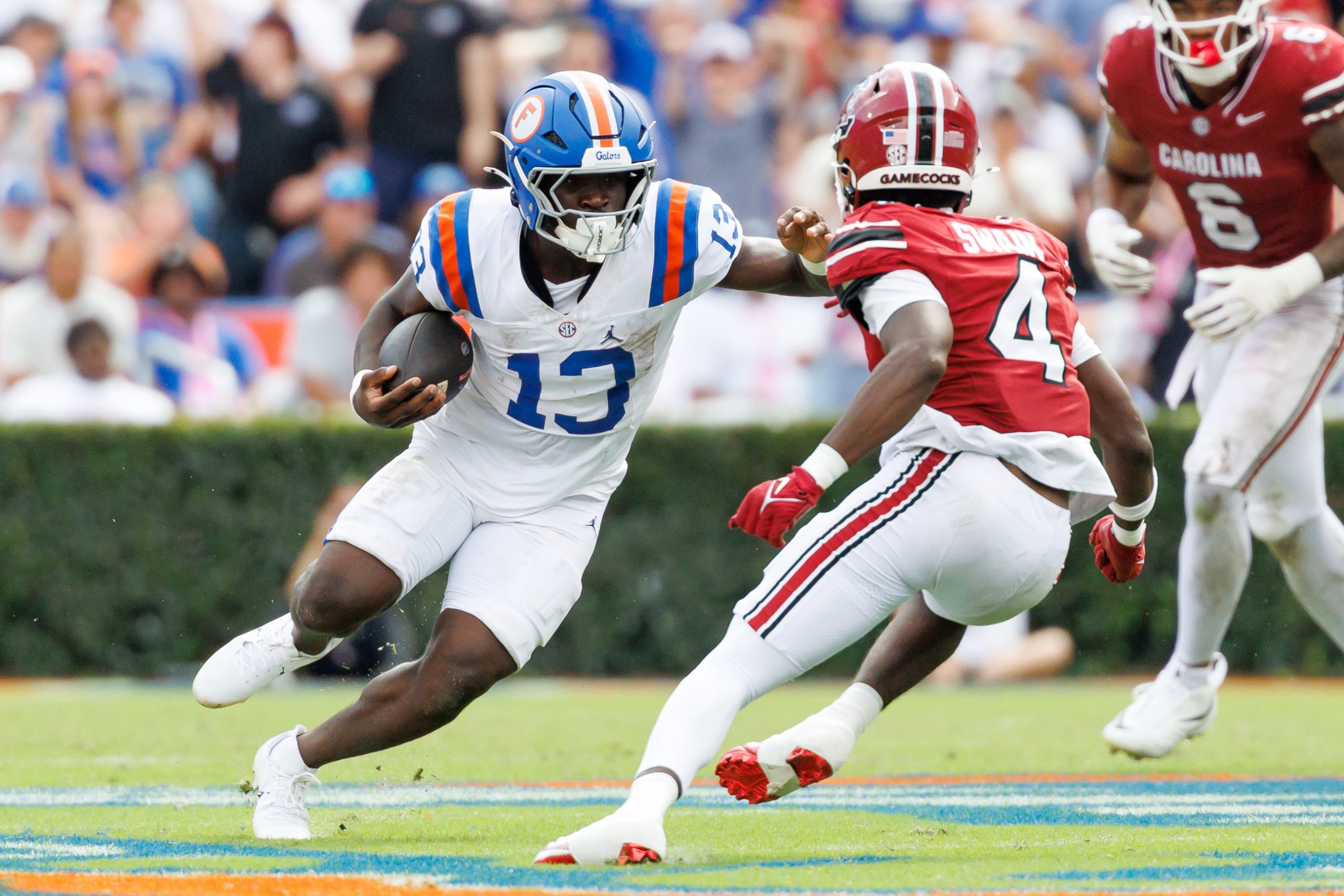
But his next three games told a different story. Against Missouri, South Carolina and Texas, Baugh managed just 163 rushing yards on 52 carries. After averaging 7.23 yards per attempt through his first four appearances, that number dropped to 3.13 across the following three. The same running back who had opened the season looking like a legitimate Heisman contender suddenly struggled to generate consistent gains. His early performances demonstrated what he was capable of, but the weeks that followed raised questions about whether that level of production was sustainable.
This is not an entirely new pattern. During his freshman season in 2024, Baugh rushed for 673 yards and seven touchdowns, but five of those scores came in one game against Kentucky. In 2025, his 266-yard performance against Florida State accounted for nearly 23% of his season rushing total. Those performances deserve recognition, particularly given his limited number of starts as a freshman. Still, across multiple seasons, some of Baugh’s most impressive statistical achievements have depended heavily on individual games rather than steady progression.
There is also an important distinction between struggling against strong defenses and struggling because of circumstances outside a running back’s control. Missouri, South Carolina and Texas all entered the latter part of October with productive run defenses, each allowing fewer than 3.25 rushing yards per attempt. Baugh was not facing favorable matchups, and Florida’s offensive struggles made those challenges even more pertinent.
Florida’s defense may also deserve some responsibility for Baugh’s declining production. The Gators surrendered 560 yards against Missouri and 393 against South Carolina, falling behind in both contests and forcing Florida to dissolve a balanced offensive approach. Baugh received just 12 carries against Missouri and 15 against South Carolina, compared with 26 against Auburn and 29 against Ole Miss. When Florida is forced to play from behind, its offense can’t always rely on the running game the way it might prefer.
However, fewer carries don’t explain everything. Baugh averaged just 2.67 yards per attempt against Missouri and South Carolina. Against Texas, he received 25 carries but managed only 3.64 yards per attempt. Even when Florida continued giving him opportunities, the explosive production that defined his opening month was absent. Offensive line performance, defensive matchups and play-calling all influence rushing efficiency, but those factors don’t erase his inconsistency.
None of this diminishes what Baugh has accomplished. His 266-yard performance against Florida State was exceptional, and his opening stretch in 2026 showed significant development. He has demonstrated the explosiveness, scoring ability and potential to become one of the SEC’s premier running backs. The question is not whether Baugh is talented enough to deliver those performances. He has already answered that.
It’s whether those performances have become the expectation rather than the exception.There is a difference between a running back capable of producing Heisman-caliber numbers and one who consistently does. Baugh’s best games have helped build his national reputation, but his quieter performances could also be a consideration when evaluating his entire workload. Until he demonstrates that his highest level of production can be sustained against a broader range of opponents and circumstances, the gap between his potential and his consistency remains difficult to ignore, and no more so than against some of the SEC’s best.
Category: Football, Gator Sports, Gators Cross Country