Florida vs. Georgia: How Location Change Impacted Fans
ATLANTA — “It’s not bad … just different.”
Those were the words repeatedly voiced in and around Mercedes-Benz Stadium in the hours before Florida-Georgia’s 3:30 p.m. kickoff Saturday.
The World’s Largest Outdoor Cocktail Party has been played in Jacksonville since 1933, barring a two-year stadium renovation break in ‘94 and ‘95. As EverBank Stadium undergoes another round of renovations, the iconic rivalry game moved to Atlanta for 2026 and will head back to Florida next season at Raymond James Stadium in Tampa.
The change hasn’t come without strife, largely due to the deeply ingrained history and tradition of the Jacksonville location in this rivalry. Most years, the stadium is surrounded by miles of tailgates, ranging from red tents of lifelong Georgia fans to rows of University of Florida fraternity buses filled with rowdy Gator students.
This year, the tailgating scene was present, but once again, “just different.”
Kathy West, a Georgia fan of 30 years has been coming to and tailgating for the Florida-Georgia game for years. Despite the closer drive, she said changes in scheduling made it difficult for annual tailgaters to maintain their positions.
West said she was informed fans could not begin setting up until 10:30 a.m., compared with Jacksonville’s standard 7 a.m. availability. Despite that information, fans were already present at the site when she arrived at the Atlanta stadium.
As for the overall atmosphere of the day, the Georgia native was disappointed.
“I don’t think this is near as exciting, near as much fun, or near as many people as it is in Florida,” she said.
A big part of that change might simply be the layout of the stadium. EverBank Stadium is surrounded by parking lots that can easily be filled with rows upon rows of rowdy Florida-Georgia fans. Mercedes-Benz’ setup is different.
Although a section of tailgating was available in the Home Depot Backyard outside the stadium, there were only around four rows of tents and one section of fanfare and sponsored tailgating areas. Tailgates existed elsewhere by the stadium and weren’t by any means difficult to find, but the setup was largely incomparable to Jacksonville. Where EverBank features one near-continuous party, Saturday’s gathering was scattered.
Ron and Mary Jo Prescott, two college football fans who have been attending the rivalry game since 1996, said it was a shift.
“In Jacksonville, there’s a lot of energy,” Ron Prescott said. “There’s people walking and yelling and doing chants constantly … Now, you’ve got them coming from all different directions. The setup is smaller.”
The location also complicated logistics of the day for many fans.
“Nobody likes to come to Atlanta,” Mary Jo Prescott said. “You’ve got to get on MARTA to get here, or pay a $100 fee to park your car. It’s just the inconvenience of it all.”
The energy shift was perhaps the most palpable conflict of the location change, however.
Aaron Johnson, a Florida fan and family member of Gator quarterback Tramell Jones Jr., made his opinion on the topic clear. With Jones being a Jacksonville native, it likely held more significance to him.
“Jacksonville is the largest outdoor party in the world … here doesn’t even compare,” Johnson said. “You see a lot more Georgia fans than you do Gator fans … the atmosphere is different, the whole energy is different.”
Still, many fans enjoyed the game, as the rivalry’s personality was evident beyond just tailgates. For a group of graduated Florida students, the competitive nature of the day began before they even reached the stadium.
While waiting for MARTA, Gabby Rochelle and Corina Dang, who are first-time attendees of the game, noticed Georgia fans gathering on one side of the station and Florida fans on the other. As fans came down the escalator, they joined their respective sides, cheering as the different fans passed. Once aboard the train, the groups mixed together, exchanging comments and playful jabs.
“We’ve gotten a few barks. Don’t know how to respond to that still,” Dang said.
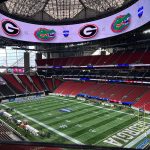
Regardless of the tailgating pitfalls, once in the stadium, any differences fell to the side. Split in half, orange and blue on one side, red and black on the other, the vibrating cheers of a deep-set rivalry filled the stands, just as they have every year prior. The only real difference was the scenic Atlanta skyline just outside the window of the end zone.
The stadium’s divided sections offered a familiar scene for a rivalry that hasn’t been played outside of Jacksonville since 1995. The setting may have changed, but the stakes remain the same for both teams.
In another similarity to recent competitions in this rivalry, Florida walked away with yet another cutting loss to the Bulldogs, following a 24-20 score in their 2025 meeting. The loss marked Florida’s sixth consecutive in the series, with its most recent win coming in 2020.
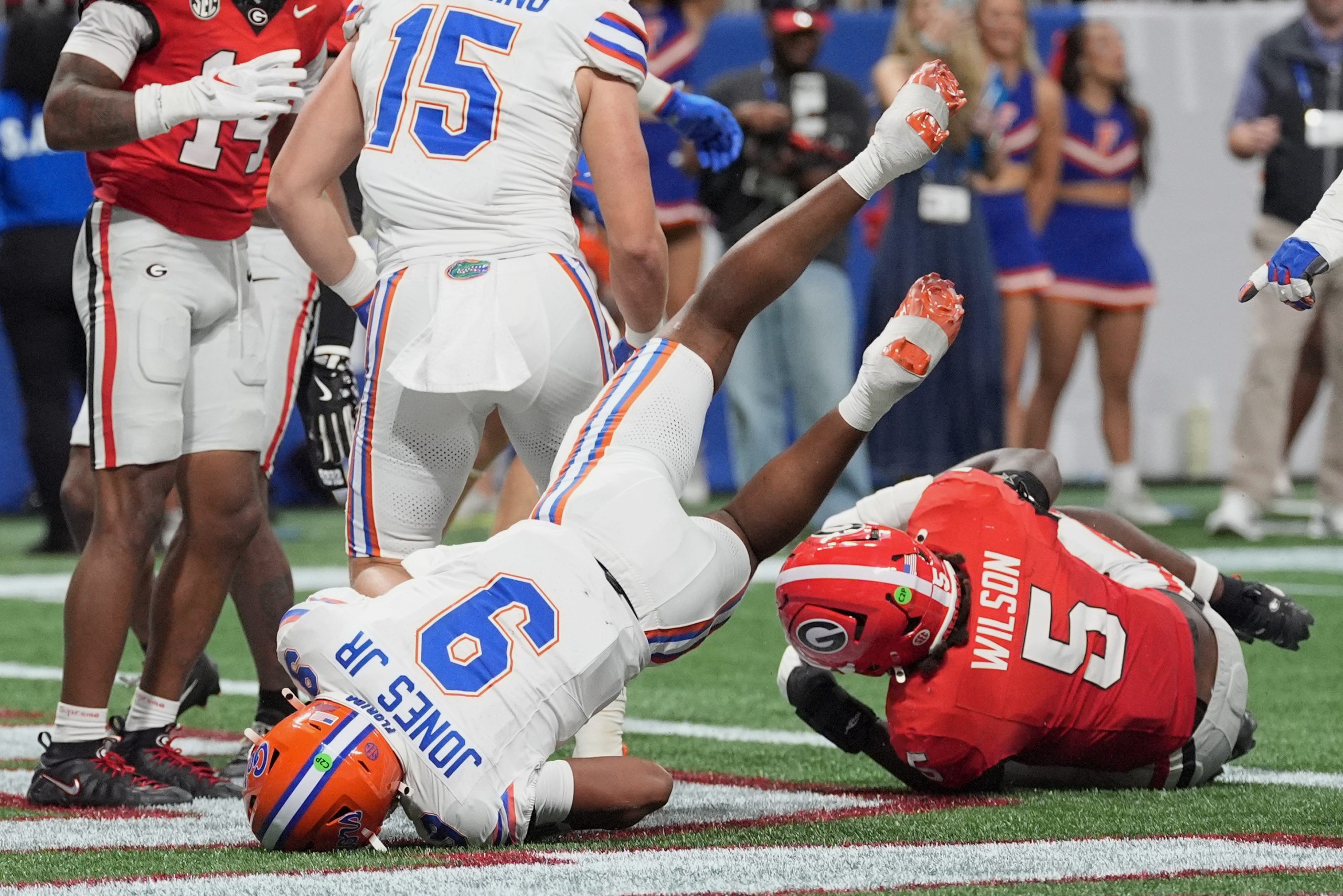
Florida spent four quarters struggling to find its footing offensively. The Gators scored their only points of the game late in the fourth quarter when Jones rushed for a 2-yard TD. Jadan Baugh was able to connect with Dallas Wilson after to notch a two-point conversion, taking their final total to eight.
Coach Jon Sumrall emphasized the fan perspective of the result following the game.
“With what the Florida Gator standard is, [we] do not shy away from the fact that we have to be a lot better,” he said. “[I’m] grateful for our fan base. They should be pissed off. I hope they are….I promise you, we’re gonna get this right.”
The loss marked another difficult chapter in the rivalry for Florida, but the experience surrounding the game offered a different kind of takeaway.
For some, Atlanta was a welcome change. For others, Jacksonville’s tradition remains difficult to replace. But as the teams return to Florida next season, Saturday showed that even when the location changes, the rivalry itself does not.
Category: Feature Sports News, Gator Sports, Gators Football