How Does Florida’s Sumrall Develop Successful Quarterbacks?
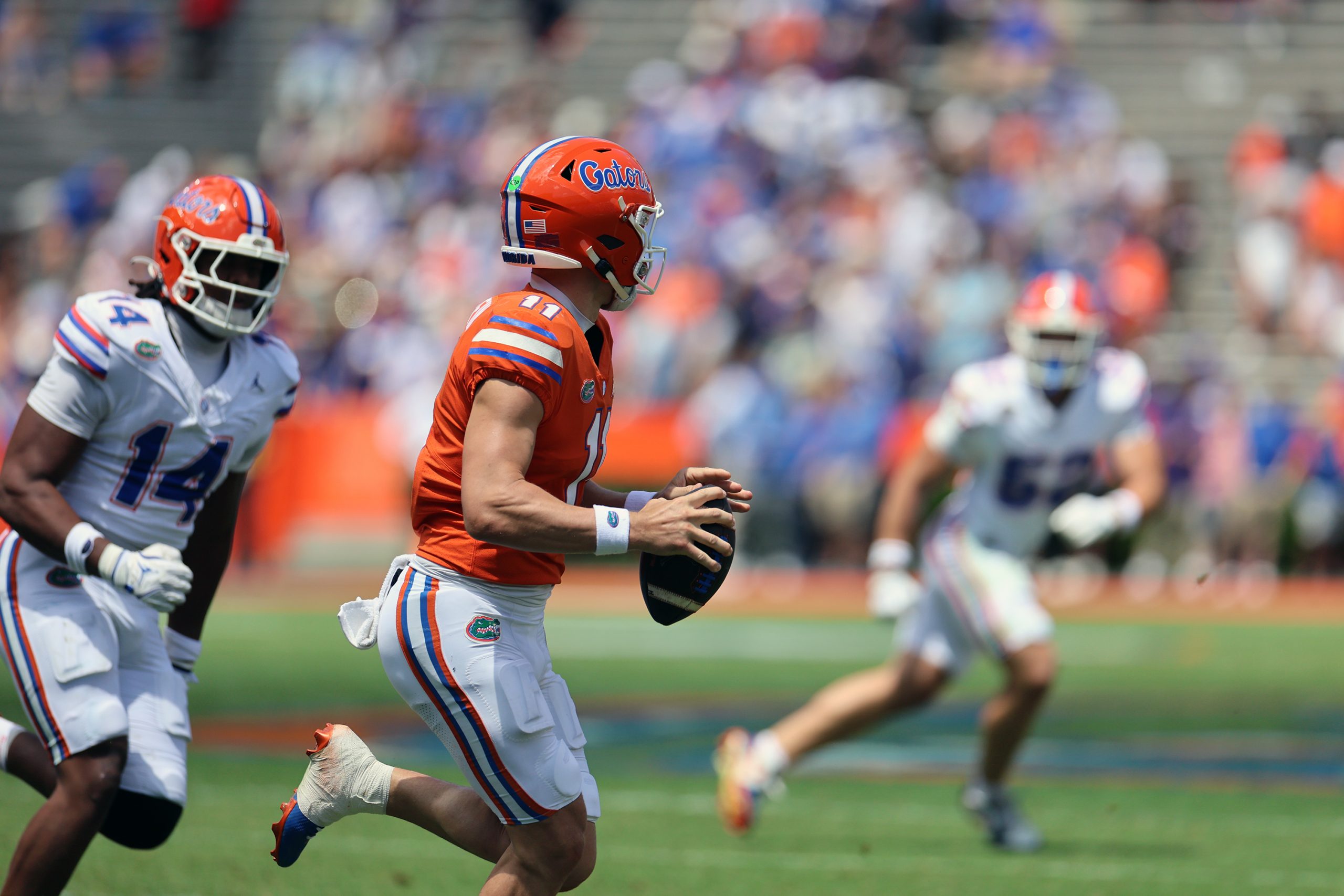
Ben Hill Griffin Stadium was loud on Saturday during the Orange and Blue spring game, but which quarterback the Gators were cheering for is another question.
Florida is getting ready to enter a new era as it continues to work out who will take the QB1 spot.
“The battle has simmered down to two, based on Saturday – Aaron Philo and Tramell Jones Jr.,” UF first-year coach Jon Sumrall said.
How did Florida get to these final two? Their determination and performance.
Previously under the leadership of Billy Napier, the Gators were chasing the hottest player within their budget, most notably Graham Mertz. Even when the team tried to develop former five-star recruit DJ Lagway, it resulted in Napier’s firing and Lagway’s transfer to Baylor.
It’s a system that historically delayed quarterback development rather than accelerating it. Richardson didn’t start a full season until Year 3, despite being one of the most talented quarterbacks on the roster from the moment he arrived. Anthony Richardson appeared in four games his freshman season, when he totaled 61 yards on seven carries and a touchdown pass against Oklahoma in the Cotton Bowl.
Richardson started all 12 games his sophomore year, finishing with 2,549 passing yards and 17 touchdowns, averaging 212.42 yards through the air per game. Richardson came out of high school as a four-star recruit, went straight to Florida and grew into being the fourth pick of the first round of the 2023 NFL Draft.
Over the past decade, Gators football has had four starting quarterbacks (Lagway, Richardson, Kyle Trask, and Feleipe Franks) who were recruited straight from high school, who were often asked to wait years before making their start on offense, while the three starting transfers (Mertz, Malik Zaire, and Austin Appleby) were brought in to win immediately. Players like Richardson and Trask had to develop patiently behind veterans before becoming starters, whereas transfers such as Mertz were expected to produce results right away. The pattern showed a program leaning on experience from outside the system instead of fast-tracking the growth of its own recruits.
Now, Florida will have to choose a new path to follow under Sumrall’s guidance.
Philo, a Georgia Tech transfer, had one clear starting opportunity this past season — a dominant outing against Gardner-Webb in which he completed 75 % of his passes and was named ACC Rookie of the Week. Before coming to Gainesville, Philo broke the Georgia state high-school record for passing yards and brings experience running a full college offense, something the Gators are counting on as they search for their next leader under center.
Jones Jr., a freshman from Mandarin High School in Jacksonville, arrived at UF known for his accuracy and decision-making. He’s comfortable staying in the pocket, working through his reads, and letting plays develop instead of relying on scrambling to create offense. Those traits have helped him quickly earn meaningful reps in the QB1 competition.
Sumrall has played a key role in that development. His system stresses footwork, pre-snap reads, and trusting progressions, teaching quarterbacks to stay disciplined and on schedule.
Under this approach, both Jones Jr. and Philo are learning to become efficient, controlled passers — a sign of how Florida’s quarterback philosophy is shifting from pure athleticism to structure and decision-making.
Category: College Football, Feature Sports News, Football, Gators Football