
Florida Men’s Basketball’s Likely NCAA Tournament Opponents
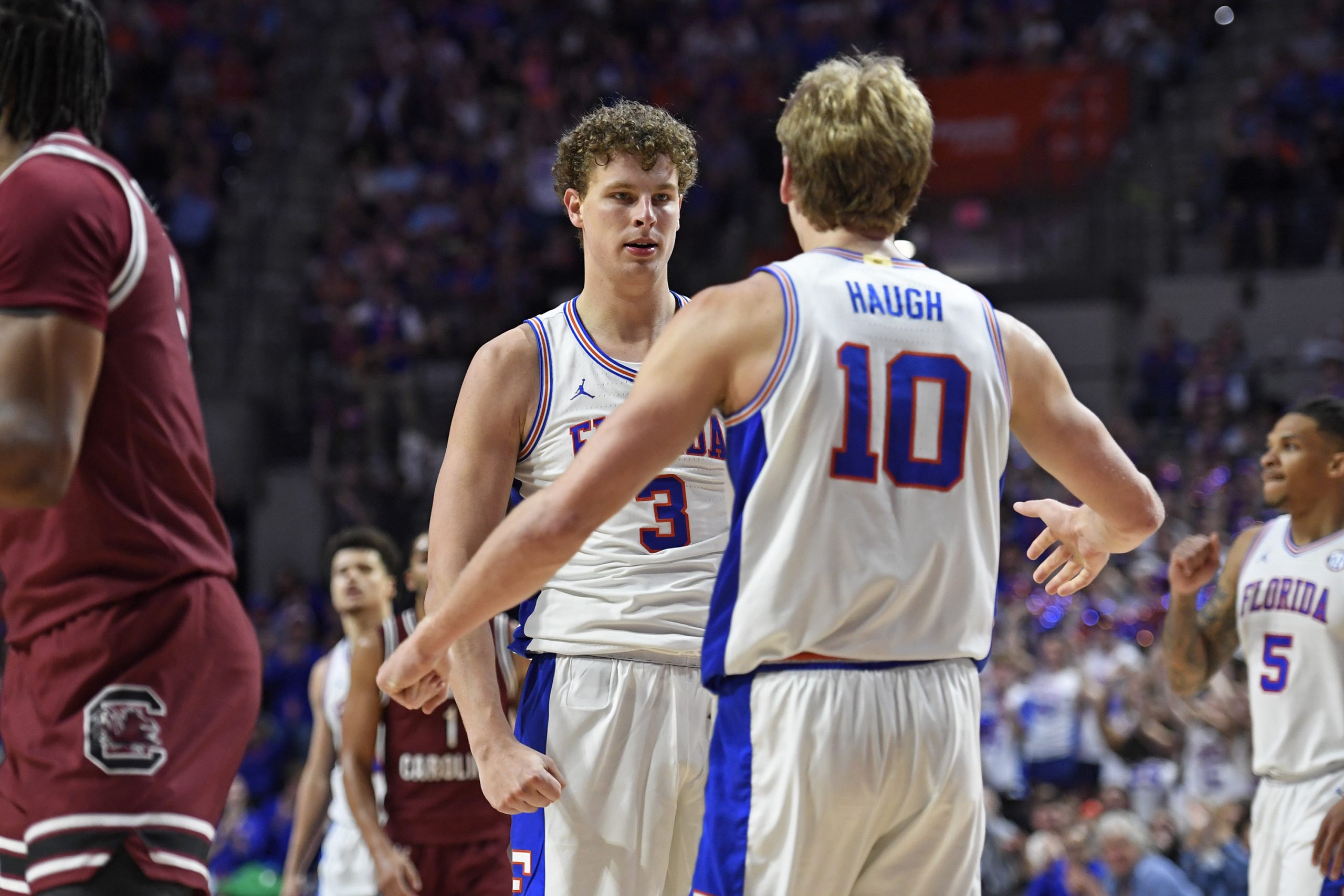
After 113 days, 16 weeks, 27 games, March Madness looms. Florida (21-6, 12-2 SEC) is a NCAA Tournament lock as the No. 7 team in the country, but where it will slot is still up in the air with four conference games and the SEC Tournament remaining before Selection Sunday.
While it is still too early to be sure of what lies ahead, it’s exactly the time for predictions, analysis and a lot of educated guessing. Per ESPN’s Joe Lunardi’s 2026 NCAA Tournament Men’s Bracketology, Florida would be a No. 3 seed, and its likely early opponents include a familiar face.
East Tennessee State – No. 14 seed
ETSU (21-8, 13-3 SoCon) is Florida’s predicted first-round matchup in Tampa. While the pair’s records tell a similar story, their difference in competition this season has been drastic.
The Buccaneers have not seen many quality opponents, their only ranked matchup against then-No. 12 North Carolina on Dec. 16, falling 77-58 to the Tar Heels. Nonetheless, like Florida, they have been dominant in their region and sit atop their conference.
A strong trio of guard Brian Taylor II and forwards Cam Morris III and Blake Barkley lead the Buccaneers. Taylor paces the team with 14.6 points per game and averages 4.1 rebounds and 2.9 assists. Morris comes in right behind him, averaging 14.4 points, 5.1 rebounds and a team-high 1.3 blocks per game. He just trails Florida’s Alex Condon’s team-high of 1.4 blocks per game. Barkley rounds out ETSU’s main offensive contributors, averaging 14 points and a team-high 5.7 rebounds per game.
ETSU is outshooting Florida across the board. The Buccaneers hit 48.7% from the field, 76.6% from the free-throw line and 34.6% from 3. Meanwhile, the Gators shoot 47.3% from the field, 70.9% from the stripe and 30.1% from deep. But both teams are most productive in the paint and struggle from beyond the arc.
However, in the matchup, Florida’s size and rebounding will be an advantage, two of the biggest reasons for its success this season. The Buccaneers’ tallest forwards are listed at 6-foot-8, while Florida’s tallest in the regular rotation is the 7-foot-1 Micah Handlogten. The Gators also average 86.4 points per game to ETSU’s 78.6.
This is a favorable matchup for Florida, especially due to the size advantage.
New Mexico – No. 11 seed
New Mexico (21-6, 12-4) is third in the Mountain West Conference and another team that hasn’t seen too many tests this season, especially when compared to the Gators. The Lobos have not played a ranked matchup all season, and their conference is only moderately rigorous, with only one other Mountain West team (Utah State) expected to make March Madness.
Yet the Lobos still have plenty of tests left, with two of their last four games against teams ranked above them in conference.
New Mexico would challenge Florida’s biggest strengths more than ETSU. The Lobos are taller, with sophomore center JT Rock matching the Gators’ primary frontcourt contributors and challenging the Gators on the boards. While not nearly as productive on the glass as the Gators, they pose more of a threat on the boards than the Buccaneers, averaging 36.4 rebounds a game.
The Lobos are led by freshman guard Jake Hall, who averages 15.9 points and 3.3 rebounds per game, and freshman forward Tomislav Buljan, who averages 11.9 points and a team-leading 9.8 rebounds per game.
New Mexico also outshoots Florida from beyond the arc, hitting 36.6%. But it is less productive than the Gators in the paint, which is where they excel.
Beyond the numbers, New Mexico is also a young team, with three of its four leading scorers being freshmen. During the bright lights of March Madness, Florida’s experience may be its biggest advantage.
Texas Christian University – No. 11 seed
In the mix for Florida’s possible opponents lies the opportunity to redeem one of its biggest losses of the season.
TCU turned out to be a tough matchup for the Gators at the Rady Children’s Invitational in November, with the Gators taking an 84-80 loss.
“The only knock on [Florida’s] resume that really bugs me in any way is TCU,” said Shawn O’Neal, the senior editor for Lindy’s Preseason College Basketball Magazine. “But TCU is the weirdest team in America. … They’ve got a couple of really crazy wins.”
Despite sitting at eighth in the Big 12, 17-10 overall and 7-7 in-conference, TCU is appearing to be a real contender for the tournament. The Horned Frogs have had a rigorous schedule, facing seven ranked teams. Amid the seven, they took down the Gators and then-No. 5 Iowa State and brought then-No. 22 Kansas to overtime.
The Horned Frogs nearly matched Florida in the rebounding battle, pulling down 28 rebounds to Florida’s 31. They picked the Gators apart defensively, forcing 19 turnovers and scoring 22 points off of them. Florida also struggled to defend TCU, committing 26 fouls.
The Horned Frogs are consistently led by forward David Punch, who averages 14.2 points, 6.7 rebounds and 2.1 blocks per game. However, it was sophomore guard Jace Posey who was the biggest problem for the Gators the last time the two teams met. He had 21 points off the bench in 21 minutes.
The Gators lead TCU across the stat chart after getting past their early-season struggles, but the Horned Frogs’ experience against tough teams from playing in the Big 12 will certainly help them if this matchup comes to fruition.
The Gators’ ability to dominate on the glass, take care of the ball and play clean defense will be deciding factors if these teams were to see each other again in the postseason.
North Carolina – No. 6 seed
How much of a threat North Carolina (22-6, 10-5 ACC) will be to the Gators depends on one thing: Is Caleb Wilson healthy?
“North Carolina is a team that so much of it is going to be dependent on, can Caleb Wilson play?” said Anthony Kristensen, Associated Press poll voter and reporter for Whole Hog Sports. “He’s going to be a top five, 10 pick in the NBA Draft. Obviously, that’s going to be a big detriment to what they want to do.”
As a freshman, Wilson is the key to North Carolina’s success. He boasts a team-leading 19.8 points, 9.4 rebounds, 1.5 steals and 1.4 blocks per game. When he is healthy on the court, it’s become a far more threatening team.
As a unit, North Carolina has withstood a tough schedule this season, topping Kansas, Kentucky, Virginia, Louisville and even Duke, current No. 1 team in the country. It has managed to remain fifth in a close, talented ACC conference.
Florida and North Carolina are averaging almost exactly the same shooting percentage from the field, but the Gators do have the edge defensively, grabbing more steals and blocks each game.
Both teams struggle immensely from beyond the arc, with the Tar Heels shooting 33.7% from deep, and like Florida, they have found much of their success through their size. North Carolina will match the Gators’ size better than any other team they will possibly play in the first two rounds right now. Their junior center, a 7-foot-1 Henri Veesaar, will look to curb Florida’s productivity on the glass.
Because of the similar size and strategy in the paint, the Tar Heels are the biggest threat to Florida on this list.
Note: Florida plays at Texas (17-10, 8-6) at 7 p.m. Wednesday on ESPN2 and coverage on WRUF’s 103.7-FM starts at 6:30 p.m.
Category: Basketball, College Basketball, Feature Sports News, Gators Men's Basketball