Carlin Hartman, Florida Basketball’s Father Figure, Relationship-Builder
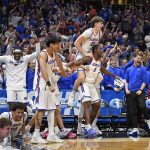
When Micah Handlogten lifted Florida assistant coach Carlin Hartman into the air after Cooper Josefberg’s 3-pointer on senior night, Hartman could only laugh.
“My legs hadn’t been in the air probably since I was at Tulane,” Hartman said. “I was in absolute shock.”
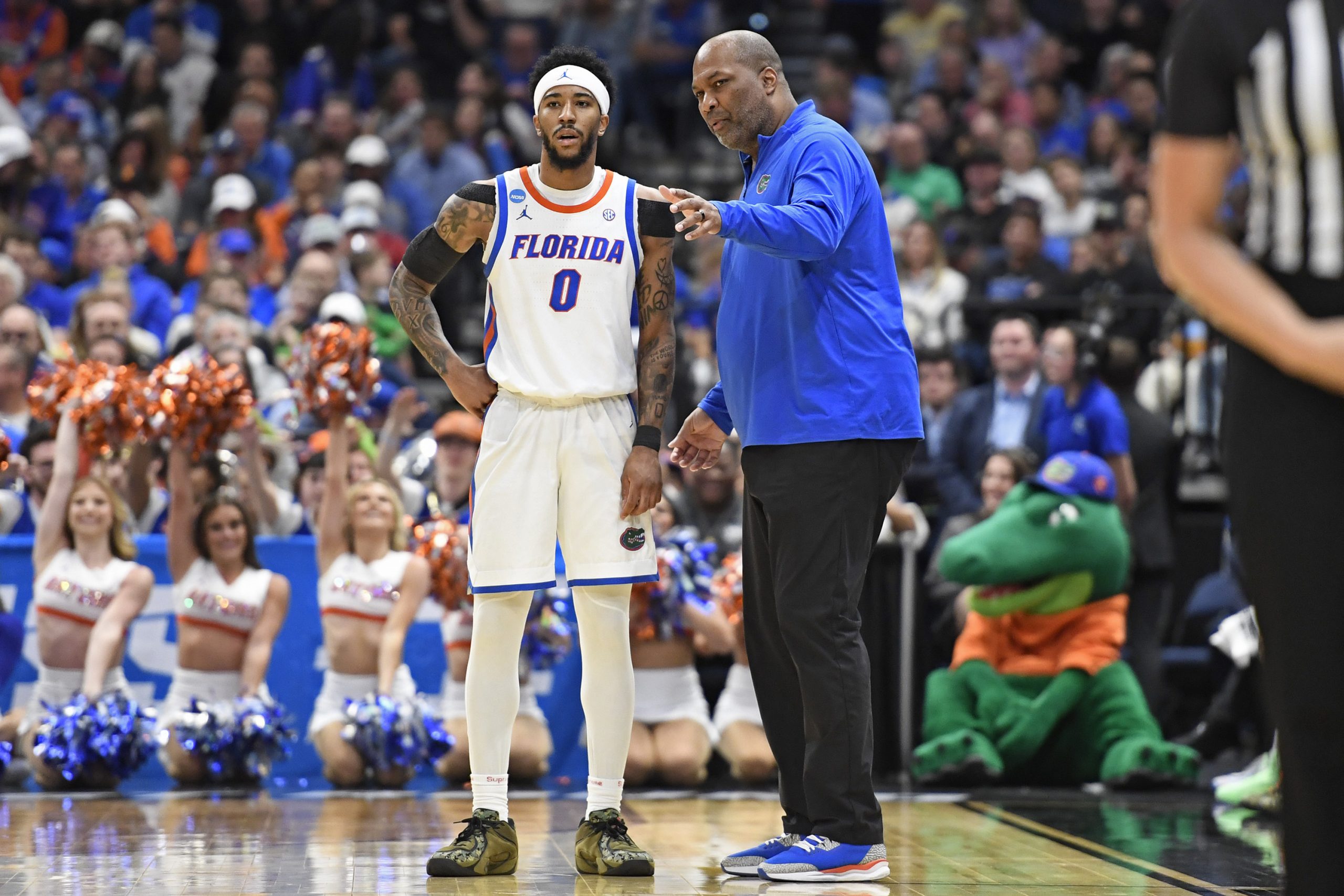
Moments like that reflect Hartman’s role inside coach Todd Golden’s Florida program. The veteran assistant is more than a coach – he’s a mentor, teacher and often a father figure to the Gators. Hartman’s impact is vibrant, undeniable and the secret ingredient to Florida’s success.
“He’s wonderful to work with because he sees you. He knows what you’re capable of doing, and he’s going to push you because he knows you can do it,” Florida center Rueben Chinyelu said. “He’s just going to push you every day as a coach, a father and a big uncle. At the end of the day, you look back and think, ‘Yeah, he pushed me. He made me better. He made me a better person, a better man.’”
Those are the words many use to describe Hartman: coach, father figure, big uncle. He’s earned them through the way he connects with Gator fans and the hospitality he shows his players. Much of Florida’s close-knit culture can be traced back to those behind-the-scenes relationships he builds.
“He knows that we have so much respect for him, and that’s why we came to Florida – to be coached by him. I think he knows how to coach each and every one of us personally. Different players require different coaching to see how they respond,” Handlogten said. “I feel like he’s been really good at separating tough coaching on the court from being very personable off the court. He’ll have us over for dinner and we’ll hang out with him, but on the court, he’s going to coach you very hard.”
Hartman’s connection with his players extends beyond the court and into his home. He and his wife, Christine, regularly invite the team to the house, making time to build relationships outside of basketball.
Over time, those visits have turned into something more familiar, with players forming connections not just with Hartman, but with his children, including his son, Joseph, and daughters, Sydney, Kailyn and Tess. The Hartman household has become a place where players feel comfortable and included. Joseph recently committed to the University of Michigan to play basketball, so having those guys around helps prepare him for the Division I level.
The night before senior night against Mississippi State, Hartman opened his home to more than just his team. The Handlogten and Xaivian Lee families gathered around his table, a reflection of something he values just as much as player development – connection with the parents and families.
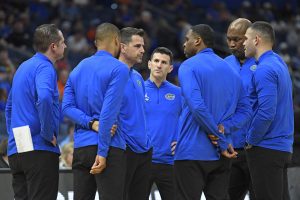
“We had the senior parents over to our house and the players were kind of doing their own thing. They were hanging out with each other, my son and a couple of their friends,” Hartman said. “The parents, myself and my wife were all hanging out together in the backyard, just talking, reminiscing about the times we’ve had.”
Hartman’s children are similar in age to the players he coaches. That perspective shapes his philosophy, rooted in treating his players the way he would want his own children to be treated.
“Being able to have my family has allowed me to be the kind of coach that I am towards our players, because it tends to lend to how I would want my children to be treated by their coaches,” Hartman said. “I would want them to have a relationship with them. But I would also want them to be coached hard and coached the right way.”
For Hartman, coaching starts with earning the right to be heard in relationships. By consistently investing in his players, he’s built the trust that allows him to coach them hard and effectively. That approach didn’t develop by chance – it traces back to his childhood in Buffalo, N.Y.
Raised by a single mother, Hartman grew up surrounded by a tight-knit family of aunts, uncles and cousins. Holidays and everyday life were shared, and he was shaped not only by his mother, but by his extended family as well. From an early age, his mother emphasized putting others first, a value that still defines how he connects with his players today.
“One of those things my mom always talked about was making it about others before you make it about yourself,” Hartman said. “And it’s just kind of been something that’s been instilled in me on a daily basis and it just becomes very natural.”
That mindset has stayed with Hartman throughout his 25-year coaching career, shaping his relationships with players and driving his commitment to making an impact on and off the court.
Hartman began his basketball career at Tulane where he ranked 10th in scoring, third on the program’s career field goal percentage list and seventh in career steals. In 2011, Hartman was named to Tulane’s 1990s All-Decade Team and following college, the Rapid City Thrillers selected Hartman in the third round of the 1994 CBA Draft.
The Tulane Athletics Hall of Famer began to see himself in coaching during his college years, but the foundation was laid much earlier. His high school coach, John Roth, along with AAU coaches Michael Hamilton and Mickey Walker, were instrumental in shaping that vision, planting the idea that one day he could lead the game the same way they did.
“I watched them pay it forward. Their time was always spent with me or other players,” Hartman said. “These men gave their time to make me a better person, and if I have the opportunity and the platform to do certain things for other people, then I’m going to do it to the best of my ability. That’s where that comes from.”
After his playing career, Hartman’s interest in coaching quickly turned into opportunity. With the support of his college coaches, he was recommended for positions that helped him break into the profession, landing his first role at Rice as an assistant coach from 1996-97.
He then moved to McNeese State for the 1997-98 season, continuing to build his path in coaching. Over the next 25 years, Hartman has worked at 11 different universities, carrying with him the same philosophy shaped by his coaches and his mother.
“I always appreciated being able to hear the truth and what I needed to work on,” Hartman said. “I also appreciated seeing them as family men, fathers and husbands, managing their time with their families and with us on and off the floor.”
Coaching hard but making sure to develop the relationship first and cherish time with family are all aspects that Hartman is known for. To extend the serving others motto from his mother even further, Hartman serves the community in many social justice initiatives.
In 2021, Golden and Hartman founded the Coaches Coalition for Progress, a group dedicated to building community relationships and expanding academic and athletic opportunities for under-resourced youth through advocacy, social impact and educational initiatives.
“It was not only a great platform for us to serve others in the community, but it also brought Todd and me closer together. Even though we had worked together at Columbia, we were able to collaborate on that project,” Hartman said. “It’s something we’re definitely proud of and, again, it’s about others.”
Hartman and Golden began coaching together in 2012 at Columbia, and his warmth and impact extended beyond the players to the coaching staff as well.
“He’s a fantastic coach and an incredible human. The simple way to put it is that he has real relationships with our guys,” Golden said. “Carlin’s done an incredible job being a fatherly influence, a great role model and someone they can lean on, both from an individual player standpoint and a coaching standpoint. We have a number of incredible coaches, but Hartman’s done a great job.”
At 54, with 25 years of collegiate coaching experience, Hartman finds himself as the oldest member of this Gators team, but he fully leans into this role.
“Todd is like my little brother,” Hartman said. “Todd sometimes calls me big bro. I’ve got a lot of nicknames on this team, sometimes the guys call me OG.”
Off the court, Hartman’s impact is clear. On the court, it shows up in production. During his time at UF, he’s developed one of the best frontcourts in the nation. The foundation of that success is his understanding of each player individually.
From the moment the big men arrive on campus, Hartman focuses on helping them grow into the best version of themselves – a process rooted in the relationships he’s built with them. Hartman doesn’t just find success at each program he goes to, he creates it.
“His impact is second to none,” Alex Condon said. “Coach Hartman gets on the players more. He’s not scared of confrontation or anything like that and always makes sure the bigs are all right. I was talking about it yesterday – the low-post hook shot that all of our bigs have now is all Coach Hartman and our development over the past three years.”
Condon, who arrived in 2023 averaging 7.7 points per game, increased that to 10.6 in 2024-25 and 14.9 in 2025-26. The progression hasn’t been without challenges. Early this season, Condon had a one-point performance against Auburn. Two games later against Alabama, he responded with 25 points and six assists. Condon pointed to Hartman, crediting him for the confidence that helped fuel that turnaround.
“Coach Hartman came to me and said, ‘The 3-point shot is just not falling, but don’t worry about it. Don’t let it affect what you do well,’” Condon said. “So, that’s what I focused on, getting to my spot in the paint and facilitating for the other guys around me.”
Chinyelu’s development tells a similar story. After arriving in 2023 and averaging 4.7 points and five rebounds, he took a step forward as a sophomore with six points and 6.6 rebounds per game. This season, he’s emerged as one of the most dominant players in the SEC, averaging 11.2 points and 11.5 rebounds.
He recorded his program-record 19th double-double with 14 points and 13 rebounds in Friday’s rout of Prairie View in the NCAA Tournament, adding to a résumé that includes SEC Defensive Player of the Year, second-team All-SEC honors and a Naismith Defensive Player of the Year Semifinalist nod. From the beginning, Hartman saw that potential and played a key role in helping him grow into the player he is today.
“With Rueben, it was a couple of different things after last year for him. Number one, controlling his emotions. He’s a highly emotional guy, that sometimes would get a little bit sped up,” Hartman said. “If Rueben is to play off of two feet with his strength it is really going to be hard for anyone to be able to stop him, because he’s such a powerful young man. He was also working on things in which he was uncomfortable with: his footwork and touch around the rim. It just was rep after rep after rep.”
All the players say the same thing: Hartman coaches them hard and they wouldn’t have it any other way. Some even came back for another year just to play for him.
That’s what made the moment stick. Handlogten lifting Hartman off the ground, both of them laughing, the rest of the team crowding around – it wasn’t just about a win. It was about everything that built up to it. The long nights, the tough conversations, the trust.
And even now, it’s still something they joke about.
“I picked up Coach Hartman, not a small guy, and he was just sitting there twiddling his little legs,” Handlogten said.
This was a quote that Handlogten’s dad sent to Hartman in a group chat with him and they couldn’t stop laughing.
“Typical Micah with his snarky little comments,” Hartman said. “I probably watched the video of Cooper’s shot and the bench’s reaction of Micah lifting me up about 50 times that night and I just can’t stop laughing.”
That moment said everything you needed to know about Hartman’s impact on this team and why it resonates far beyond the court.
“It’s just a fun environment to be a part of, and something that I almost pinch myself about on a daily basis, that not only you know that I’m a part of, but I think to myself, like, wow, I’ve been a huge part of building this,” Hartman said.
“I’m just extremely proud of these young men that we are around on a daily basis and our staff. We’ve really done a lot of really good work, and hopefully the best is still yet to come.”
Up Next
Top seed Florida (27-7) faces nine seed Iowa (22-12) in the second round of the NCAA Tournament at 7:10 p.m. Sunday on TBS. Radio coverage on 103.7-FM begins at 6:40 p.m.
Category: Feature Sports News, Gators Men's Basketball