How Florida Coaches Debuted Against Georgia
What Florida coaches’ first Georgia games reveal about the road ahead for Jon Sumrall
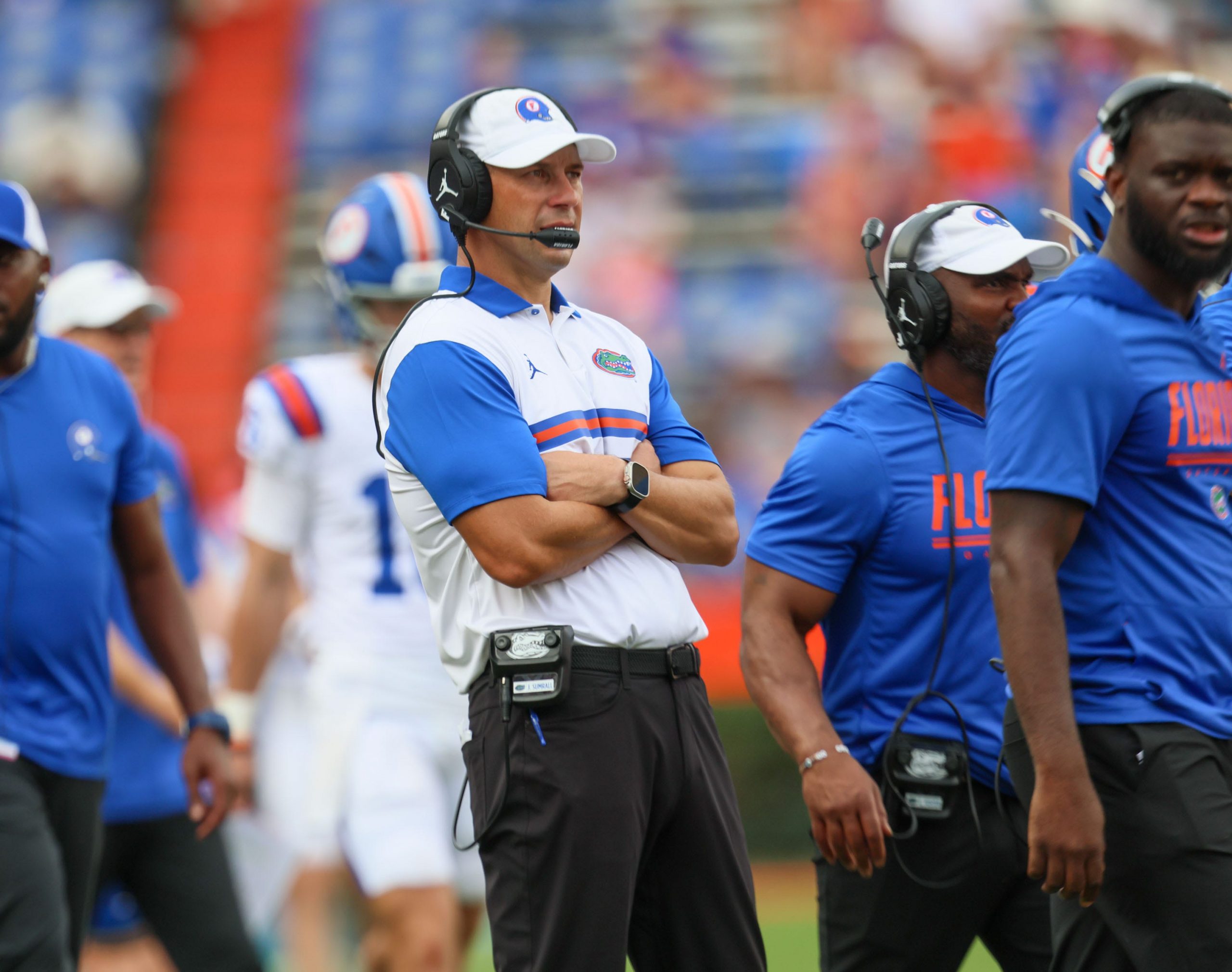
Jon Sumrall will get his first taste of the World’s Largest Outdoor Cocktail Party on Saturday. For a fan base desperate to regain dominance against the Dawgs, this offers an early look at how his program compares to one of the best in college football.
Sumrall enters the weekend 5-2 with two wins over top 10 teams : No. 4 Ole Miss and No. 7 Texas. Those victories have already given Florida reasons for optimism, especially with its ability to hold up against elite teams. Beating No. 3 Georgia would add a rivalry breakthrough to Sumrall’s early success, along with another top 10 win.
Florida’s history shows clear reasons to value how important this first impression is, but also reasons to be careful about how much it truly predicts.
Since Steve Spurrier arrived in 1990, four of Florida’s seven permanent head coaches have won their first meeting with Georgia. Two went on to win national championships. Two were gone before ever completing their third season.
The three who lost their debuts never won an SEC championship at Florida. But their experiences also show that an opening loss in the rivalry doesn’t prevent a rebound, just as an opening win doesn’t guarantee success.
Spurrier entered his first Georgia game in 1990 with a 6-2 record and delivered a 38-7 blowout. It became an early example of the control Florida would establish over the rivalry during his era. He finished 11-1 against the Bulldogs, with Georgia’s only win coming in 1997. Across 12 seasons, Spurrier went 122-27-1, won six SEC championships and delivered Florida’s first national title in 1996. So, yeah, this Georgia game showed that Spurrier was ready to win big at the University of Florida.
However, the opponent matters, and that Georgia is not the Georgia of late. The Bulldogs finished 4-7 in 1990 and across the 1990-2001 seasons, the Bulldogs went 88-51-1.
Spurrier deserves credit for maintaining his dominance through Georgia’s better seasons in that span. But beating the 1990 Bulldogs is a lot less impressive than beating what Georgia has become under coach Kirby Smart.
On the opposite end of the Spurrier spectrum, Ron Zook provides the clearest warning against treating a first-year Georgia win as a sure sign of a successful tenure.
Florida entered the 2002 meeting at 5-3 and beat Georgia 20-13. The Bulldogs finished 13-1 and won the SEC, the Gators responsible for their only loss.
This was a win over a legitimate championship team and one similar to the caliber of this year’s Georgia squad. In the 2002-04 seasons, Georgia went 34-6, winning 85% of its games. Zook then beat Georgia again in 2003 and finished 2-1 in the rivalry. Yet Florida never developed the consistency needed to meet the expectations he inherited from the Gator legend that came before him. He finished 23-14 and lost his job during his third season.
His debut remains an unbelievable win, but it also demonstrates that beating Georgia can be a high point without becoming a foundation.
Not every win against an elite Georgia team is a fluke, though. Urban Meyer turned an early win against the Bulldogs into sustained success after entering the 2005 game at 5-2 and beating No. 4 Georgia 14-10.
Georgia played without injured starting quarterback D.J. Shockley, leaving Joe Tereshinski III to make his first career start. Safe to say, he was unprepared for the moment. Regardless, the Bulldogs finished 10-3 and won the SEC. That opening victory became part of a sustained advantage. He went 5-1 against Georgia, finished 65-15 at Florida and won national championships in 2006 and 2008. Georgia went 54-24 across his six seasons, good for a 69.2% winning percentage. Those Bulldogs featured strong teams, although they didn’t maintain the level of dominance Georgia has reached more recently.
For Meyer, the first win was an indication that Florida could keep control of the rivalry while building toward championships.
Will Muschamp’s first meeting went the other direction.
Florida entered at 4-3 in 2011 and built a 17-3 lead before collapsing and losing 24-20. The Gators produced just 32 yards of offense in the second half, allowing Georgia to turn a good Florida start into another frustrating loss.
However, Muschamp rebounded with a strong 11-2 season in 2012, but a 17-9 loss to Georgia proved costly. Both teams finished 7-1 in SEC play, and the Bulldogs advanced to the conference championship game because of their win over Muschamp. He then went on to lose one more time before eventually winning 38-20 in 2014. That breakthrough couldn’t rescue his tenure. Muschamp finished 28-21 and the Gators’ dismissed him later that season. His first loss didn’t rule out a strong second year. The larger problem was Florida’s inability to sustain success, with Georgia repeatedly standing in the way.
Jim McElwain entered his first Georgia game at 6-1 and won 27-3 in 2015. Florida won again in 2016, and McElwain claimed SEC East titles in each of his first two seasons. For a while, the rivalry results supported the belief that Florida was moving back toward regular contention. But Georgia was evolving. McElwain beat coach Mark Richt’s final Georgia team in 2015 and Smart’s first. By 2017, Smart’s Bulldogs had taken a major step forward, though, and they haven’t looked back since.
Georgia’s 42-7 victory in 2017 became McElwain’s final game at Florida. The school announced his firing the following day, ending a 22-12 tenure.
Georgia went 31-10 from 2015 to 2017, but that merges different stages of the program: 10-3 in 2015, 8-5 in 2016 and 13-2 in 2017. Smart took over a quality 10-3 team, had a mediocre Year 1, and rapidly turned the corner. In fact, after Georgia fell to Vanderbilt, Florida with a win of its own, and Georgia hasn’t lost two games in a row since. Fittingly, Florida looks to repeat history a decade later following Georgia’s loss to Auburn .
Dan Mullen arrived at his first Georgia game with a 6-1 record in 2018 and lost 36-17. That defeat didn’t derail his first season. Florida finished 10-3, followed with an 11-2 season in 2019 and beat Georgia 44-28 in 2020 on the way to an SEC East title.
Mullen nevertheless finished 1-3 against the Bulldogs and 34-15 at Florida. His tenure ended in 2021, the season Georgia won its first of back-to-back national championships.
Across the 2018-21 seasons, Georgia went 45-8, winning an ungodly 84.9% of its games. Mullen showed that a coach could recover from a first-year rivalry loss and build a contender. Sustaining that contender status proved to be the more difficult leg.
Billy Napier faced a championship contender immediately and found himself in a boat race. Napier entered the 2022 matchup at 4-3 and lost 42-20 to a Georgia team that finished 15-0 and repeated as national champions.
Unlike Spurrier’s first opponent, Napier’s first meeting came against a Georgia edition that represented the sport’s highest standard, one of the most talented teams in college football history. He finished 0-3 against the Bulldogs and 22-23 overall before Florida dismissed him in October 2025 ahead of that season’s rivalry game.
Georgia went 51-6 in Napier’s time — an 89.5% clip, if anyone’s counting. That record includes games played after Napier’s departure, but it shows the strength Georgia maintained in recent years.
The challenge Georgia presented during Napier’s time was unbelievably steep, but Florida’s lack of progress ultimately left Napier without enough success to offset a string of rivalry losses.
For Sumrall, a win Saturday would provide an immediate rivalry breakthrough and evidence that Florida can challenge Georgia under his leadership.
The best way to predict the future is to analyze the past.
Spurrier and Meyer made beating Georgia a habit while winning championships. Zook and McElwain earned early wins without building the same staying power. Muschamp and Mullen produced strong seasons after losing their debuts, but neither maintained a championship program.
The first meeting matters because it gives a new coach an opportunity to establish credibility in a rivalry that carries enormous weight. Its lasting value depends on whether the program keeps improving.
Sumrall’s first Georgia game will become part of the story of his tenure. The seasons that follow will determine how that opening chapter is remembered.
Category: Football, Gator Sports, Gators Football