Is Florida’s Offense Good or Bad? Yes.
From explosive to dull, it has truly been the tale of two different months under coach Jon Sumrall’s new Florida football program. The Gators leaped into the national image with commanding wins in their first four games, but have lost some momentum in October.
The Gators began their season with four straight wins. Victories over Auburn and No. 4 Ole Miss established Florida as one of the top offensive teams in the country. “Run the Baugh” and “Baugh4Heisman” conversations abound, as UF’s star running back Jadan Baugh led the country in touchdowns.
However, consecutive losses to Missouri and South Carolina exposed wounds that were Band-Aided through the early success. Even though Florida upset No. 7 Texas two weeks ago, the Gators have struggled to replicate the offensive rhythm it had in September. The Florida-Georgia game Saturday will be a massive test for the Gators offense against a tough Georgia defense.
Throughout the first four games, Florida averaged 53.5 points and 532.8 yards per game. Then a switch flipped, and during their three October games, the Gators offense has only been able to manage 21 points and 341.7 yards per game. The Gators’ average yards per play also fell from 7.6 in September to 4.7 in October.
Florida’s September success came from its ability to establish the run and subsequently create explosive passing opportunities. However, struggles along the offensive line, injuries to key players and a decline in big plays interrupted the offense’s flow.
Baugh was almost unstoppable in the first four games, rushing for 600 yards and 11 touchdowns against Florida Atlantic, Campbell, Auburn and Ole Miss. Not to mention, sophomore running back Duke Clark added 259 rushing yards, giving Florida one of the best rushing duos in the country.
But in the Gators’ first game of October against Missouri, Baugh finished with 13 yards on 12 carries. That struggle only continued against South Carolina a week later, as he recorded 59 yards on 15 attempts.
Baugh has totaled 163 rushing yards and two touchdowns through his last three games, a considerable decline in the scope of his season.
Another major factor to Florida’s offensive decline has been the performance of its offensive line. It’s struggled to provide consistent protection and openings for Florida’s backs.
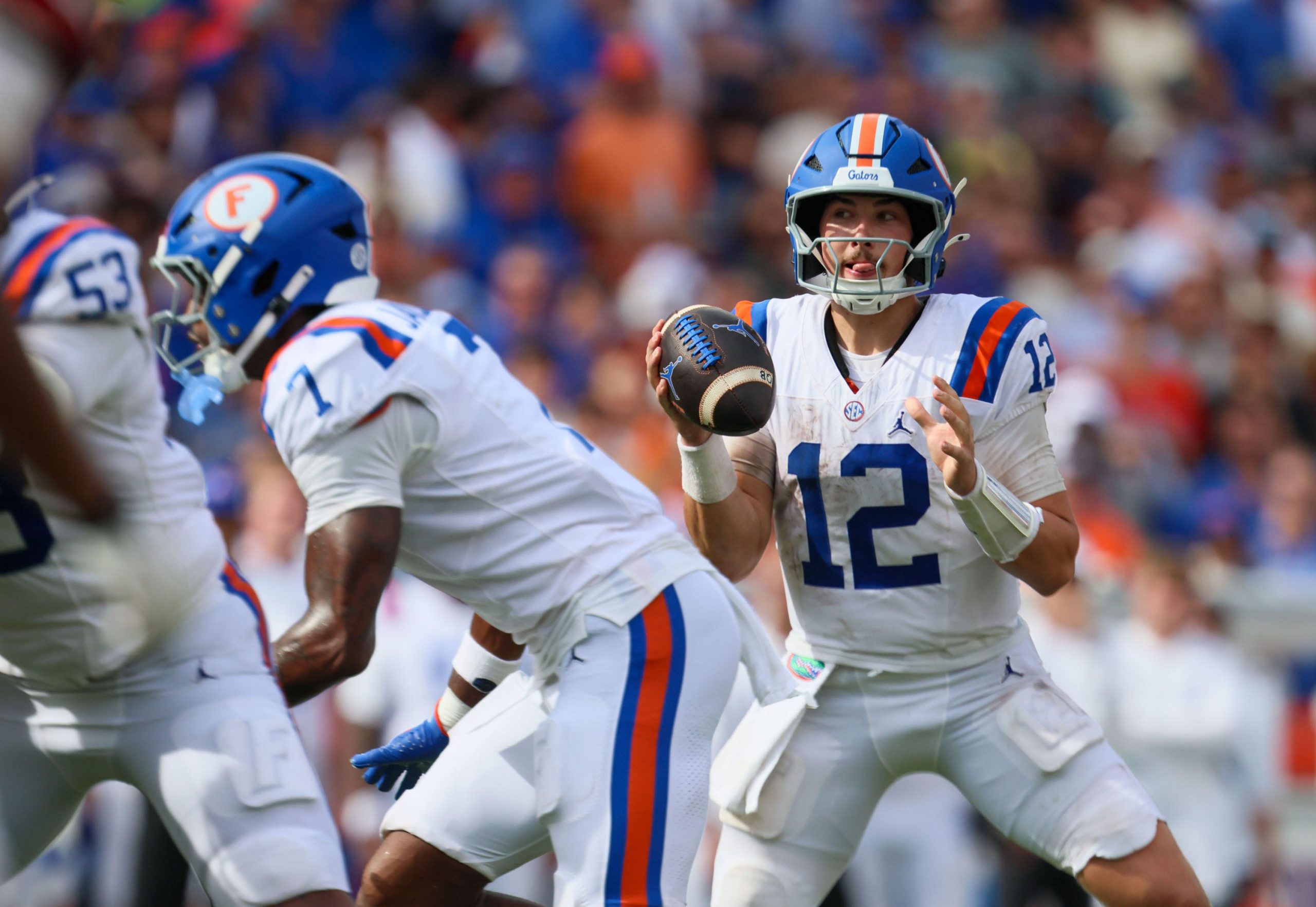
Quarterback Aaron Philo was only sacked twice in September, both against Auburn. In October, Philo was sacked six times — three against Missouri and three against South Carolina, before suffering a shoulder injury and missing the Texas game.
Those protection problems have carried into Florida’s quarterback play.
In their four September victories, Philo threw for 917 yards and seven touchdowns. In Florida’s games against Missouri and South Carolina, he passed for 424 yards, losing a fumble and tossing an interception.
Florida then started sophomore quarterback Tramell Jones Jr. in Philo’s wake for the Texas game.
He completed 62.9% of his attempts for 155 yards and two touchdowns. Although the Gators won, their passing game looked night and day different from September. Notably, Florida averaged 10.5 yards per pass in its first four games, which has now dwindled to 6.4 in October.
Injuries at the wide receiver position have also challenged the Gators.
Receiving and punt-return threat Vernell Brown III suffered a knee injury against Ole Miss and has missed Florida’s last three games. Brown III recorded 271 receiving yards, two receiving touchdowns and two punt returns touchdowns in September.
When looking at Florida’s entire offensive unit, they have committed 55 penalties for 522 yards over the entire season thus far, which ranks them 22nd in the nation for most penalty yards.
The Gators’ win over Texas provided signs of improvement, especially in Florida’s ability to control possession time. However, Florida’s penalty problems trickled in, as it still added seven penalties for 55 yards against Texas.
September demonstrated what the Gators’ offense is capable of when all of the position groups are healthy and cohesive.
If the Gators can rediscover the explosive offense that fueled their undefeated September, then they might have a shot to go far. Its first shot is Saturday against No. 3 Georgia in Atlanta, where the Gators hope to get a second consecutive SEC win.
Category: Football, Gator Sports, Gators Football