Gators men’s basketball returned home Tuesday for the final game of the preseason against Stetson, and it took a half for the Gators to find their footing. Although the O’Connell Center wasn’t filled to its usual capacity, Florida got a taste of the excitement for the preseason No. 1 team in the country.
The Gators took the court without the services of junior guard Boogie Fland, who was out with an illness.
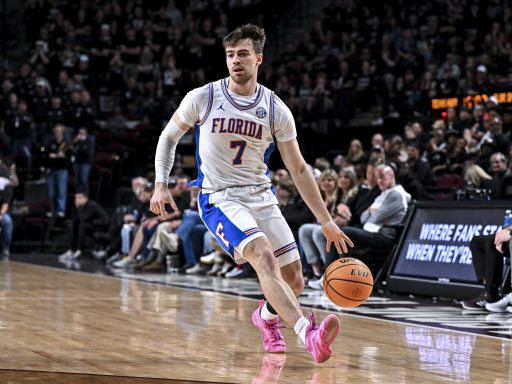
Taking his place in the starting lineup was Urban Klavzar, who found his stroke in the second game of the preseason. Klavzar started the preseason rusty, shooting 0-for-5 from three against Baylor. The reigning SEC Sixth Man of the Year responded with a game-high 24 points, six 3-pointers and a 50% shooting percentage from three, re-certifying himself as a surefire sniper from deep.
It was a disappointing first half of basketball for Florida, which went into halftime with just a 42-40 lead against the Hatters. The last time the two programs played, Florida dominated Stetson 85-45 in 2024.
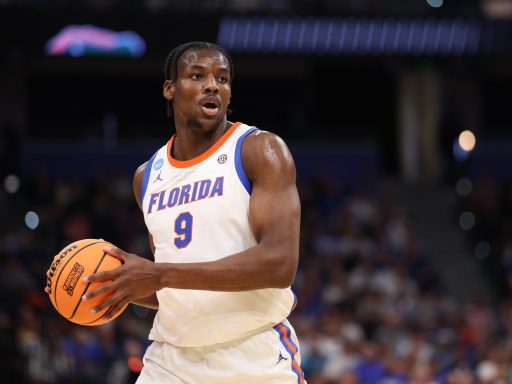
Florida struggled inside, going 13-for-22 on layups against a Stetson defense that double-teamed when the Gators entered the paint. Rueben Chinyelu had a quiet night against the Stetson defense, going 3-for-8 from the field for six points, though he did pull down eight rebounds.
The Hatters were effective getting desired matchups in the first half, with an offense featuring flurries of on-ball screens. Smaller guards consistently got matched up with Florida’s bigs, including Thiago Sucatzky, a 5-foot-10 sophomore who had 14 points in the first half. Sucatzky was the spark plug of the Hatters offense, finishing with 18 points and six assists. Alex Doyle matched him with 18 off the bench, going 6-for-9 from deep.
But in the second half, Florida came out firing, amassing a 10-point lead in less than seven minutes of play. The defense followed, holding a Hatters offense that went stagnant to 10-for-31 shooting. Florida still led by just seven with under four minutes left before closing on a 10-0 run to win 85-68.
Denzel Aberdeen was the other powerhouse of the Gators offense with 22 points, shooting 80% from deep and 75% from the field after an 0-for-10 3-point performance against Baylor. The fifth-year transfer from Kentucky added four rebounds and three assists with no turnovers, taking the ball up for Florida in the place of Boogie Fland.
The shooting struggles that appeared against Baylor were mostly silenced in the final tune-up game of the preseason as the Gators shot 40.7% from 3-point range and 50.8% from the field. But when the game stopped and the referee passed the ball to a Gator at the free-throw line, fans witnessed much the same.
Florida shot 8-for-15 from the line to Stetson’s 7-for-9. After shooting 22-for-35 against Baylor, the Gators are starting a trend of not capitalizing on shots from the line, shots that are properly nicknamed: free.
After a Baylor exhibition that saw nine players hit the court, coach Todd Golden searched for depth on the Gators bench, using Artūras Butajevas, Domen Petrovič and Alex Lloyd for the first time this season. Golden mixed the players in with the starting lineup, and although their role was minimal, the three combined for four points. Eleven Gators played, but Stetson’s bench outscored Florida’s 28-4.
Throughout the preseason, the workload of the starting lineup never slowed down. Against Baylor, which went to overtime, all five starters played over 33 minutes, with Thomas Haugh and Alex Condon playing 38 each. It was much the same against Stetson, as every starter played at least 30 minutes aside from Condon, who played 29.
The Gators have just six days before the first game of the season against No. 14 Miami at Benchmark International Arena in Tampa, the same place where the Gators lost in the round of 32 to Iowa last season. Jai Lucas, a former player for the Gators, is the head coach of the up-and-coming Hurricanes, hoping to give an early challenge to the team with the highest expectations in the country.